


Malaysia is one of the most popular expat destinations. I came here four years ago and settled on Penang Island on the Malaysia My Second Home visa (MM2H).
I’ve had zero regrets about my decision to leave England and set up home here. Malaysia is filled with rich culture, basks in a tropical climate and is renowned for delicious food fusions. It’s an easy and comfortable life.
If you've ever considered moving to Malaysia, I hope this article will give you some insight. I'll focus on the major considerations that anyone who’s thinking of moving abroad should examine carefully.
Short on time? Here's the cheat sheet:
💭Moving to Malaysia could be the perfect opportunity for you, if you can meet the legal requirements to do so.
🛂Most foreigners living here are on either a MM2H visa, Employment Pass, Residence Pass, or the DE Rantau Nomad Pass.
🏠Although I've chosen to live in Penang, other top considerations are Kuala Lumpur, Ipoh, Johor Bahru, Melaka, Kuching, or Kota Kinabalu.
🤕Don't rely on luck alone. SafetyWing now offers 2 types of Nomad Insurance coverage options: Essentials for travelers and Complete for expats and digital nomads.
☂️You'll have to fight the mosquitos and humidity but,
☀️The excellent healthcare, friendly locals, efficient public services, and outstanding natural beauty make it worth it.


Why Malaysia?
'Malaysia, Truly Asia'.
Malays, Chinese, Indians and an assortment of other Asian peoples have been living side by side for centuries and they’ve all had an influence on what Malaysia is today.
Makanan (food) seems to be the reason for living for most Malaysians; every part of Asia is represented on the culinary spectrum. Mosques, Chinese temples, Indian temples and Christian churches all rub shoulders amongst the colonial buildings and steel and glass skyscrapers. The festivals of Chinese New Year, Hari Raya, Deepavali, Thaipusam, Gawai and Kaamatan follow on each others’ heels, then Christmas comes along. English is widely spoken, along with most other Asian languages.
The foreigners I’ve met here have been drawn to Malaysia for all of the above as well as the cost of living, comfortable lifestyle and the absence of Northern Hemisphere winters. Or any winter at all for that matter, as the Australians will testify.
Malaysia offers excellent international schools and international brands of every commodity are available in the stores and online. Public transport is generally efficient and regular. KL has an expanding MRT (Mass Rapid Transit) system which, by all accounts, is easy to use. City bus services are good and Grab, the Asian equivalent of Uber, is super-easy to use via phone app and very inexpensive.
People consider becoming expats for a variety of reasons and Malaysia caters for most of these. Be aware though that permanent residency is rarely an option.
So if Malaysia’s on your radar, here’s a breakdown of those important considerations.
Things You'll Likely Love about Living in Malaysia

The Cost of Living
It's rising, as it is everywhere, but there’s no denying that Malaysia is very affordable compared to Western countries. Some commodities ARE expensive, like cheese, beef and alcohol.
Ease of Communication
Many locals speak some English, a lot are fluent and signs usually always have English alongside the Bahasa Melayu. Business with foreigners is conducted in English and often official documents have both languages.Efficient Public Services
Electricity and broadband supplies are reliable and we have safe, potable tap water. The municipalities maintain public spaces and roads well, although sometimes the markings can be - er - interesting!
International Banking Options
Expats can open Malaysian bank accounts. This includes digital nomads, although a few banks may differ on this. Several international banks operate here and their global banking options are used by many expats.
Warm, Equatorial Climate
With a small temperature range of high 20s to low 30s Celsius, the climate has definite health benefits for many older people. Expats from northern Europe and the USA/Canada in particular are very taken with the equal days and nights.
Delicious Food in Incredible Variety
If you want to eat it, you’ll find it and you’ll have the opportunity to try more new food experiences than you ever thought possible. Malaysians love fusions, given their diverse ethnic backgrounds. Costs vary – cheap hawker stalls, fine dining at international prices and everything in between.
Excellent Healthcare
Malaysia is famous as a ‘medical tourism’ destination with healthcare provided at a lower cost than in Western countries as well in some other Asian countries. The private hospitals are top notch, with English speaking medical professionals.
Outstanding Natural Beauty
Malaysia offers lush forests, amazing coastlines and fascinating limestone karst and cave systems. There’s abundant, diverse wildlife and conservation is gaining in importance among young generations.
Extensive Expat Community
You'll find yourself in a welcoming community that can get you useful contacts for anything you need. Expat life involves many social functions, advertised in weekly e-newsletters. I never wanted to limit myself to the expat enclave, however. Anyone can join social clubs and activity groups and, as a ‘guest’ in a foreign country, I’ve made it my business to get to know locals as well.
Ease of Travel around Southeast Asia
There’s a whole world at your fingertips only a short and often low cost flight away. Explore Thailand, Indonesia, the Philippines, Vietnam, Cambodia and Laos, then move a little further afield to India, Hong Kong, China, Taiwan and Japan.
Things You Might Not Love about Living in Malaysia
Long ago, when I was considering leaving Zimbabwe for England, someone told me that choosing to live where the problems suit you best is a sound philosophy when moving abroad. Malaysia has its share of issues like any country. Below are those most likely to affect expats.
The Humidity
Many expats here love the heat, but most find the humidity a challenge. Everywhere is air conditioned, but running a/c constantly in the home can be costly. Fortunately most homes have ceiling fans as well. It’s a definite advantage to live as high as possible. Our apartment is usually cool from the natural breeze.
Mosquitos
It’s mozzie country, so a bottle of insect repellent in your bag is essential. For night time adventures (wildlife safaris, firefly watching) wear long trousers and sleeves. It’s rare to come across mosquitos in shopping malls and in the food courts but if you want to live near ground level you’ll have to take all measures to keep them at bay. The municipalities carry out ‘fogging’ on a regular basis.
The Battle for Building Maintenance
The Southeast Asian mindset doesn’t consider property maintenance important. Owners of apartments can face an uphill struggle to get the management committee to invest in life cycle planning or preventative maintenance. A number of ‘super condos’ manage this very well but of course you end up paying more for this benefit.
Traffic & Driving
Kuala Lumpur and Penang suffer from heavy traffic, especially during public holidays (which is often!) and drivers have to grin and bear it. I’ve often been known to mutter, in 'Manglish', “Ah. Is very jam today.”
Driving can be erratic but is not nearly as terrifying as in India or Vietnam. It’s essential to be very, very aware of motorcyclists, however. In any accident the blame is highly likely to be placed onto the driver with four wheels rather than the one with two.
Getting a license here can be a challenge but more on that specific quest below.
Best Places to Live in Malaysia
Expats gravitate to locations suited to their lifestyle and stage of life. On peninsular Malaysia, foreign workers cluster in KL, Johor Bahru and Penang where most of the international organisations are set up.
Digital nomads, those working online and retirees usually head for Penang, Ipoh and Melaka. In East Malaysia, these kinds of expats find the slower life style in Kuching and Kota Kinabalu appealing. A few live on Langkawi island.
Expats working in the hospitality industry can be found wherever there are resorts.
Kuala Lumpur

It’s a busy international city so you must expect everything that goes with that.
I’ve not lived there, but from acquaintances I know that Damansara, Bangsar and KLCC are districts favoured by expats. Damansara and Bangsar are affluent, attractive residential neighbourhoods, with many cafés, bars and restaurants, close enough to the city centre to be convenient. There's a lot of things to do in KL so boredom shouldn't be an issue.
A friend of mine lived in Kuala Lumpur city centre for six years. She loved the convenience and says that walkability around the district is excellent (many elevated walkways) so you don’t have to fight the traffic in any way.
She admits the traffic jams are challenging and although it makes sense to reside as close to your workplace as possible, it isn’t always possible. Retirees and remote workers are able to choose homes where they want to spend most of their time, only travelling across this extensive city for important business.
It’s a buzzing city where it’s easy to meet people and make friends but it’s one of the more expensive places to live. Climate-wise it’s often stormy and gets showers nearly every day.
Read more about living in Kuala Lumpur.
Penang

Penang is an entire state but the most popular place to live is Penang Island. I’ve lived here for four years and it feels like home.
There’s plenty of local entertainment and the night life buzzes. Penangites love to claim that their state is the food capital of Malaysia, if not the world. Name a cuisine and you can find it here, plus multiple fusions.
Expats are found everywhere but the highest concentration is spread across the north of the island, from George Town, through Pulau Tikus, Tanjung Tokong and Tanjung Bungah, to Batu Ferringhi. The views from accommodation near the shore are spectacular, those in the east benefit from glorious sunrises and those in the west, beyond Pearl Hill, getting the best sunsets.
The Gurney Drive/Pulau Tikus district has some of the most prestigious condos and is therefore the most expensive place to rent or buy.
Expats also live in newer residential developments in Gelugor, immediately north of the original Penang Bridge (there are two bridges). It’s an up-and-coming place with convenient access to both George Town and the mainland.
Penang is as humid as the rest of Malaysia but coastal breezes are a welcome relief most days and it definitely cools during the wettest months.
Read more about living in Penang.
Ipoh

Ipoh is a former tin‑mining boomtown that’s now known for its heritage buildings, lakes, caves and white-water rafting as well as the intriguing Kellie’s Castle. Very good coffee is produced in this region.
The cost of living is a bit lower than the major centres. Most expats collect in the condos and gated communities located south and east of the city.
Friends who moved from Penang find public transport and shopping good. The same supermarket chains that operate in Penang stock many imported goods. They’re happy that the traffic is not nearly as congested too.
Ipoh’s climate is similar to that of KL and, being inland, it doesn't get the sea breezes.
Johor Bahru

Literally just across the Johor Strait from Singapore, JB’s industries take advantage of the close proximity to Singapore by offering cheaper land and labour for regional operations. It’s also a commuter city for cross‑border workers.
Popular places to look for accommodation include the Iskandar Puteri area, the city centre/waterfront and eastern and northern suburbs. Expats live in a mixture of landed property, gated communities and condos here. Those who cross the border to Singapore regularly usually cluster in the city districts.
Mount Austin has a lively café/nightlife culture that suits younger foreign workers and families wanting lower rental prices than Iskandar Puteri.
JB gets heavy monsoon rains from November to January.
Melaka

Melaka is best known for its Portuguese and Dutch colonial heritage streetscapes and strategic position on the Strait of Malacca and, like George Town, is a UNESCO‑listed historic site. It's also one of the best places to visit, even if moving here isn't quite right for you.
Melaka’s home to expats who are retired and keen on history and culture. It has a slower pace of life and more affordable living than KL and Penang. The high rise developments with sea views just a short drive from the old town are most popular.
Melaka is wet in the middle of the year in contrast to most other places.
Kuching & Kota Kinabalu
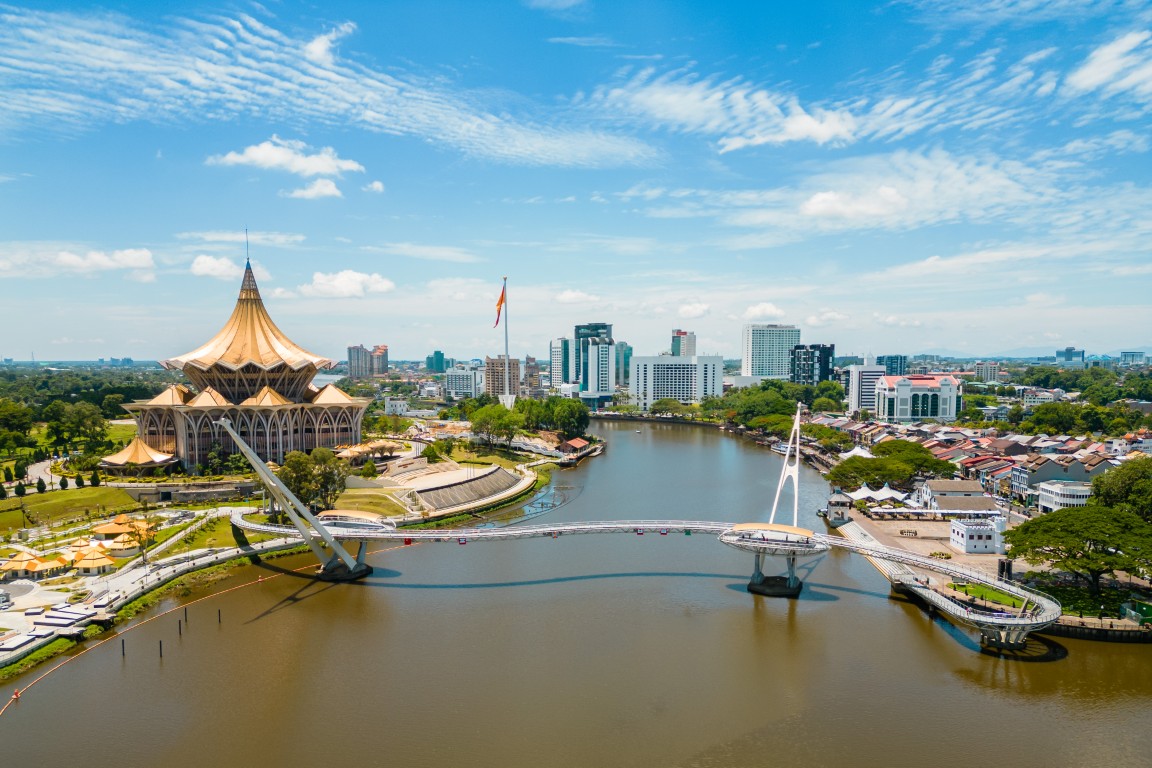
Now we move to East Malaysia and the two states of Sabah and Sarawak, within Borneo.
Kuching is one of the wettest places in Malaysia, with often over 400mm of rainfall per month during November to February. Even ‘dry’ months get around 200mm.
It’s a quieter, low rise city with a riverfront core and proximity to beautiful coastal areas and inland national parks. The waterfront and central areas are popular with expats and digital nomads who want walkability to cafés and bars. Those who prefer to live near malls, supermarkets and international schools choose landed houses and condos south of the city.
Kota Kinabalu was originally known as Jesselton and was virtually destroyed in WWII. Rebuilt post‑war, it’s now the state capital of Sabah. KK is not quite as wet as Kuching, but still gets its fair share. It’s coastal, so it gets good sea breezes. Tourism is strong here as it’s a good base for both marine and mountain/wildlife reserve excursions.
Favourites for expat life are the city centre/waterfront (vibrant lifestyle, cafes, restaurants) and the coastal suburbs. Many retired expats opt for the outskirts with gated communities that are more relaxed but still within commuting distance of the city.
Visa Types
Malaysia offers a number of long term visa options. Be aware that the rules can change overnight (yes, literally!) so please check with a professional for up to date information and eligibility.
Malaysia My Second Home (MM2H)
This visa was very popular and brought many, often retired, expats to the country. In the past few years, however, the requirements for new applicants have changed dramatically, making MM2H less affordable and less appealing to most.
It’s now split into several tiers with a 5-20 year validity depending on the tier. You'll need to lodge a fixed deposit in Malaysia and purchase property, to be owned for a minimum of 10 years. The values of the deposit and property vary by tier.
Only holders of the Platinum tier are allowed to work in Malaysia. Other MM2H holders cannot be employed or offer services for payment locally but they can work online for companies that source all their business, and pay salaries overseas.
Employment Pass (EP)
This work visa is for anyone with a job offer from a Malaysian based company. Company sponsorship is required and it's subject to minimum salary thresholds and relevant qualifications. The EP allows dependents to accompany the employee.
Long Term Social Visit Pass (LTSVP)
This is granted to spouses/dependents of Malaysian citizens and to dependents of those on the EP and foreigners with permanent residency. You'll need proof of relationship and a sponsor in Malaysia. There's a minimum income requirement for the sponsor and restrictions on working, unless authorisation is obtained.
Residence Pass‑Talent
This special 10 year option can be granted for highly skilled professionals who are already working in Malaysia, although continued employment is essential. This visa also allows dependents.
DE Rantau Nomad Pass
This is the one for digital nomads. It’s valid for anything from 3–12 months and can be extendable with multiple entries allowed. You must provide proof of your remote work, your monthly income, valid health insurance and valid passport (14 months minimum left).
Settling into Life Here

Living successfully as an expat involves acceptance and understanding of the way of life in your new country, which may have a very different culture to your own.
Malaysian Daily Life
Life in Malaysia will not be a complete culture shock.
The modern amenities and high quality services will be like those in your home country. It feels international and embraces up to date technology. Yet there is a distinct cultural shift to be made on some levels and you need to know you’ll be comfortable with this. That’s not to say it’s anything bad – just different.
There’s a kind of chaotic and untidy charm about living in the Far East. As an example, in Penang we have a popular seafood restaurant called Tsunami Village (located where the 2004 tsunami hit the island) that's accessed via a boat engine repair shop. You pick your way through a cramped, dark workshop, stepping over tools and bits of engines, scenting the oil in the air, and then emerge into an open eating area with a sea view. The tables have plastic covers and the chairs are all mismatched. But the food served is hygienic, wonderfully fresh, tasty and excellent value for money.
Malaysia is a Muslim country so you need to be aware of dress protocols when entering governmental buildings and, of course, mosques. You’ll hear the call to prayer five times a day wherever you live.
My fellow expats all agree on this – you’ll feel welcome. Customer service is almost always open and friendly. Be warned that everyone will want to know everything about you and your background, but it’s only from curiosity, so have no concerns. It's a cultural difference you'll have to live with.
Monsoons
All of Malaysia is affected at some point by monsoons, resulting in high rainfall. There are two monsoon seasons and their impact varies significantly by region. This means that often one side of the country is wetter than the other at any given time of year.
Health Insurance Costs
Although healthcare is very reasonable compared to other places, you should consider having private health insurance, as expats get no welfare benefits. Foreign nationals I know pay for minor procedures, consultations and dental work as they go but opt for health insurance for hospitalisation. This can be a significant expense, depending on your choice of policy.
International Schools
Malaysia's top international schools are distributed throughout the country. KL, JB and Penang have the highest concentrations but they exist away from the major cities as well. Offering a variety of global curricula, including British, American, Australian and International Baccalaureate, they have excellent reputations and focus strongly on student wellbeing.
Working at an international school in Malaysia is also a good option for qualified teachers looking for a stable job in-country.
Safety
Malaysia is a place where you’ll feel safe. As with everywhere in the world, you should always have common sense safety awareness, but apart from some petty crime and bag snatches, personal attacks/robbery are rare.
House burglaries can occur and individual landed properties tend to be the targets. Most expats, even those who swore they would never do apartment living – like me – opt for a condo because it’s ‘lock up and leave’ safe.
Driving License
Foreigners on most long term visas can get a local driving license. The application requirements never seem to be the same from year to year, however, and vary depending on the source of your original license, so an up to date check is necessary.
In 2022 we were permitted to obtain a Malaysian license based on presentation of our British licenses and proof of eligibility from the UK Driver and Vehicle Licensing Agency, although we were given provisional permits for two years. We now have full Malaysian licenses but I’m pretty sure there’s been a change for some nationalities recently that means you might have to take a local test.
So, Is Moving to Malaysia the Right Choice for You?
If you’ve never visited Asia and have never lived abroad, my advice would be to come on vacation before making any decision on moving to Malaysia. While vacationing can’t be compared to daily living, you’ll at least get a flavour of our easy Asian life.
All pictures courtesy of depositphotos.com.


.png)
.png)


